Winding through the heart of Europe, Germany's Castle Road, or Burgenstraße, offers a journey not just through picturesque landscapes but through the very pages of history itself. Stretching over 1,200 kilometers from Mannheim in the west to Prague in the Czech Republic, though predominantly in Germany, this famed tourist route is a tapestry woven with the threads of knights, emperors, and legends. It is more than a mere collection of stones and mortar; it is a living narrative of power, romance, and architectural evolution, waiting to be explored by those with a thirst for the past and an eye for beauty.
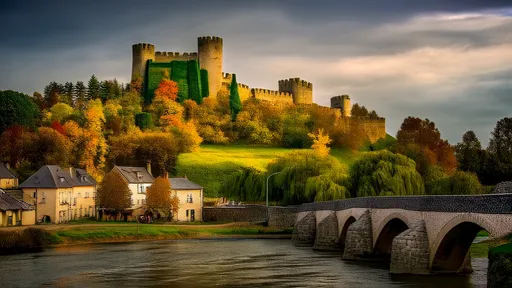
The very concept of the Castle Road was born in the post-war 1950s, a deliberate effort to create a cultural and historical trail that would reconnect people with Germany's rich heritage. It was designed to guide travelers through a region where history feels palpably close, where around seventy castles, palaces, and fortresses stand as silent sentinels over river valleys and hilltops. Each structure tells its own story, from formidable medieval strongholds built for defense to opulent Renaissance palaces designed for lavish court life. The route itself is a lesson in historical geography, following ancient trade routes and strategic paths that were once the lifeblood of the Holy Roman Empire.
Commencing the journey in Mannheim, a city known for its grid-pattern layout, offers a stark contrast to the ancient ruins and romantic palaces that lie ahead. While the city's Baroque Mannheim Palace is a grand introduction, the true adventure begins as one travels eastward into the Neckar Valley. Here, the landscape softens into rolling hills and dense forests, with the river carving a path through the countryside. This region is the soul of the Castle Road, boasting an incredible density of historic sites. The town of Heidelberg is often considered the unofficial capital of this route, and for good reason. Its world-famous Heidelberg Castle, a magnificent red sandstone ruin, dominates the view from the old town. Though partially destroyed by war and fire, its grandeur is undiminished. Walking through its vast courtyards and terraces, one can easily imagine the intellectual and cultural fervor of the court of Elector Friedrich V, who created the stunning Hortus Palatinus gardens. The castle's presence is so profound that it has inspired poets and artists for centuries, embodying the Romantic ideal of beautiful decay.
Further along the Neckar, the journey reveals smaller yet equally captivating gems. Hornberg Castle, perched high above the river, was the home of the legendary knight Götz von Berlichingen, known for his iron prosthetic hand and his defiant spirit. Not far away, the perfectly preserved Guttenberg Castle has never been destroyed and remains inhabited to this day. It is a working museum of knightly life, complete with a renowned falconry center where birds of prey soar against the backdrop of the valley. This section of the road is a continuous panorama of history, with castles like a string of pearls along the riverbanks, each visible from the next.
As the route continues into Franconia, the character of the castles begins to shift. The terrain becomes more rugged, and the structures reflect a more militaristic past. This is the land of imperial cities and powerful prince-bishops, and their fortresses were built to project authority and withstand siege. The city of Nuremberg, a major hub on the route, is guarded by its immense Kaiserburg (Imperial Castle). This complex was one of the most important fortified imperial palaces of the Middle Ages, a symbol of the power of the Holy Roman Emperors. From its ramparts, the view stretches over the red-roofed old city, a scene that has changed little in centuries. Another formidable sight is Cadolzburg Castle, a sprawling complex that offers a deeply immersive experience into the world of the Hohenzollern dynasty, complete with recreations of medieval life that engage all the senses.
No tour of Franconia's fortresses would be complete without mentioning the crown jewel of the region: Rothenburg ob der Tauber. While technically a walled town, its impeccable preservation and towering defenses make it a castle in its own right. Walking its cobbled streets is like stepping into a living storybook, completely enclosed by medieval walls and watchtowers. Further east, near the Czech border, the landscape culminates in dramatic fortresses like Pottenstein Castle, nestled in the lush greenery of Franconian Switzerland, and the sprawling, fairy-tale complex of Prague Castle, which marks the traditional end of the route, connecting German and Bohemian history in a grand finale.
Beyond the stones and histories, the Castle Road is a journey for the senses. It is a culinary trail through Germany's heartland. Travelers can stop in a vineyard along the Neckar River to sample a crisp Riesling or a full-bodied Trollinger wine. In Franconia, they must indulge in the region's distinctive beer, often served in traditional stoneware mugs, accompanied by hearty fare like Nürnberger Bratwurst or Schäufele (slow-roasted pork shoulder). The route also celebrates seasonal festivals, from medieval markets that spring up in castle courtyards, filled with artisans and minstrels, to Christmas markets that transform ancient town squares into winter wonderlands. For the active traveler, the well-marked trails between castles offer unparalleled hiking and cycling opportunities, allowing for a slow, intimate discovery of the landscape.
To truly travel the Castle Road is to embrace a mindset. It is not a route to be rushed. The greatest pleasure lies in the unplanned stops—the small village Gasthof with a view of a ruin, the conversation with a local vintner, or the quiet moment spent looking out from a castle tower over a valley that has witnessed a thousand years of history. It is a personal pilgrimage where one can choose to delve deep into the history of a single site or simply soak in the romantic atmosphere. The road invites you to create your own adventure, to find your own castle, and to become part of its ongoing story.
In the end, Germany's Castle Road is far more than a simple line on a map. It is a vibrant, breathing monument to European history, a showcase of architectural genius, and a testament to the enduring power of legend and landscape. It promises an unforgettable experience, leaving every traveler with not just photographs, but with the echoes of knights and the whispers of empires, long after the journey is done.
By /Sep 1, 2025
By /Sep 1, 2025

By /Sep 1, 2025
By /Sep 1, 2025
By /Sep 1, 2025
By /Sep 1, 2025

By /Sep 1, 2025
By /Sep 1, 2025
By /Sep 1, 2025
By /Sep 1, 2025

By /Sep 1, 2025

By /Sep 1, 2025
By /Sep 1, 2025
By /Sep 1, 2025
By /Sep 1, 2025
By /Sep 1, 2025

By /Sep 1, 2025
By /Sep 1, 2025
By /Sep 1, 2025
By /Sep 1, 2025