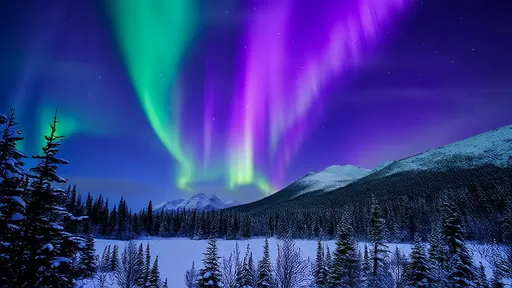
There are few natural phenomena that capture the human imagination quite like the Aurora Borealis. For centuries, these shimmering curtains of light have danced across the northern skies, inspiring myths, legends, and an insatiable desire in travelers to witness their magic firsthand. To see the Northern Lights is to experience one of nature’s most breathtaking performances—a display that feels both profoundly ancient and intensely alive.
Many describe the aurora as a once-in-a-lifetime experience, and for good reason. It’s not just about the lights themselves, but the entire journey—the anticipation, the cold, the silence of a Arctic night, and the overwhelming sense of wonder when the sky finally erupts in color. It’s a pursuit that requires patience, planning, and a bit of luck, but those who have stood beneath the glowing heavens often say it was a moment that changed them.
The science behind the aurora is as fascinating as the sight itself. Solar winds carry charged particles from the sun across space, and when these particles collide with Earth’s magnetic field, they are drawn toward the poles. There, they interact with gases in the atmosphere—oxygen and nitrogen—creating the brilliant greens, pinks, purples, and reds that ripple across the sky. The result is a celestial light show that feels both random and perfectly choreographed.
To maximize your chances of witnessing the aurora, timing and location are everything. The lights are most frequently visible during the winter months, from September to March, when the nights are longest and the skies are at their darkest. Prime viewing locations include Northern Norway, Swedish Lapland, Finland, Iceland, and Northern Canada. Remote areas, far from the light pollution of cities, offer the clearest and most dramatic views.
But seeing the Northern Lights is about more than just checking a box on a bucket list. It’s about embracing the atmosphere of the far north—the crisp air, the stark beauty of snow-covered landscapes, and the warmth of a fireside retreat after hours spent gazing upward. It’s the thrill of the chase, the camaraderie among fellow aurora hunters, and the quiet humility that comes from witnessing something so much larger than ourselves.
For those willing to venture into the cold and the dark, the reward is unparalleled. There is no guarantee—the aurora is a natural phenomenon, elusive and unpredictable. But that’s part of what makes it so special. When the lights do appear, shifting and swirling in a silent, electric ballet, it feels like a gift. A moment of pure magic that remains etched in memory long after the journey home.
This is why so many travelers return from the Arctic with a sense of awe—and a desire to go back. The Northern Lights don’t just dazzle the eyes; they stir the soul. And in a world where so much can be planned and controlled, it’s a powerful reminder of nature’s ability to surprise, delight, and inspire.

By /Sep 1, 2025
By /Sep 1, 2025

By /Sep 1, 2025
By /Sep 1, 2025
By /Sep 1, 2025
By /Sep 1, 2025
By /Sep 1, 2025
By /Sep 1, 2025
By /Sep 1, 2025

By /Sep 1, 2025
By /Sep 1, 2025
By /Sep 1, 2025
By /Sep 1, 2025
By /Sep 1, 2025
By /Sep 1, 2025
By /Sep 1, 2025

By /Sep 1, 2025
By /Sep 1, 2025
By /Sep 1, 2025

By /Sep 1, 2025